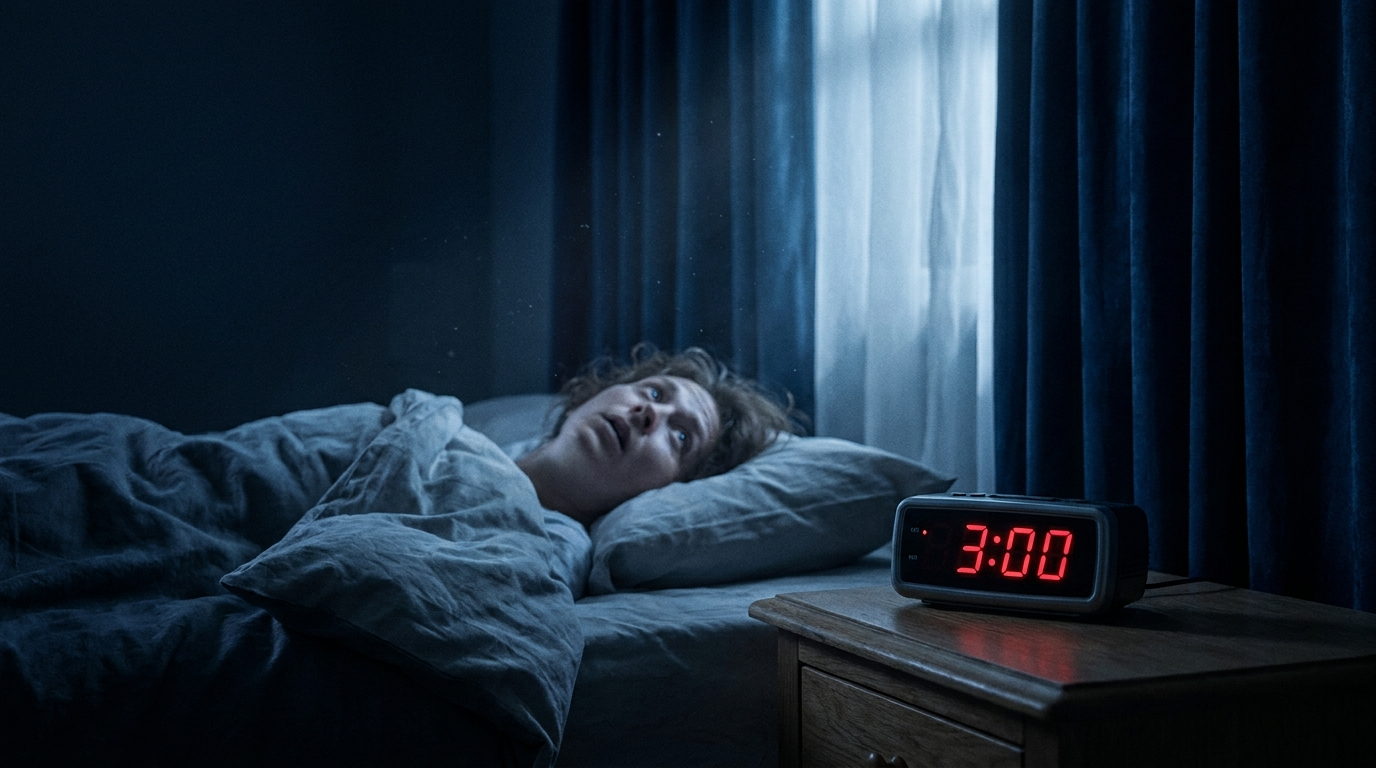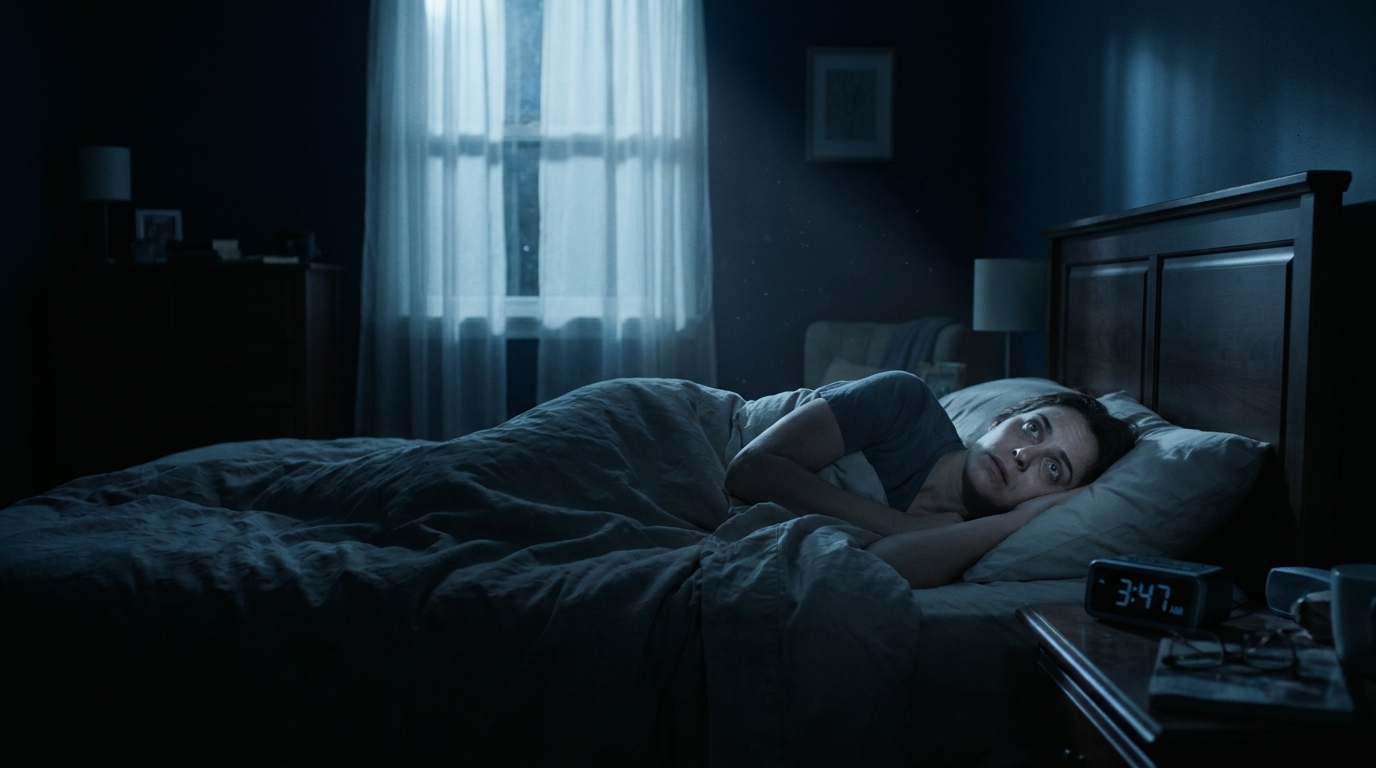
You're exhausted all day. You get into bed at a reasonable time. And then nothing. Forty-five minutes pass. An hour. Your mind won't stop. This is sleep onset insomnia — and it affects roughly 30% of adults at some point.
Why Melatonin Probably Isn't Your Answer
Melatonin is a timing signal, not a sedative. It tells your brain "it's getting dark" — it doesn't knock you out. If you can't fall asleep, the problem is almost never a melatonin deficiency. It's usually one of three things: your cortisol is too high at bedtime, your sleep pressure isn't high enough, or you've developed conditioned arousal — your brain has learned to associate bed with wakefulness.
High Cortisol at Bedtime
Cortisol and melatonin are on opposite schedules. Cortisol should peak in the morning and drop to its lowest around midnight. But chronic stress, evening exercise, bright light, stimulating content, or late eating can keep cortisol elevated. When cortisol is up, melatonin can't rise effectively. You lie there wired and exhausted at the same time — what researchers call "hyperarousal." This is the most common cause of sleep onset problems.
Insufficient Sleep Pressure
Sleep pressure is built by adenosine — a molecule that accumulates the longer you're awake. If you napped after 3pm, spent the day mostly sedentary, or woke up later than usual, you may simply not have built enough sleep pressure by bedtime. The fix isn't an earlier bedtime — it's often a later one, combined with more daytime activity.
Conditioned Arousal
This is the sneakiest one. After weeks of lying awake in bed, your brain starts to associate the bedroom with alertness rather than sleep. Every time you get into bed, your nervous system activates. It's a conditioned response — the same mechanism as Pavlov's dogs, but with anxiety instead of saliva. Stimulus control therapy (a core part of CBT-I) addresses this directly.
What the Evidence Says Works
Cognitive Behavioral Therapy for Insomnia (CBT-I) is the gold standard — more effective than sleeping pills, with no dependence risk. The key components: sleep restriction (temporarily limiting time in bed to build pressure), stimulus control (bed is only for sleep), and relaxation techniques. Of the relaxation techniques, physiological sigh (double inhale through the nose, long exhale through the mouth) and box breathing (4-4-4-4) have the most direct cortisol-lowering evidence. The 4-7-8 technique is slower and particularly effective for the hyperaroused state.
The Protocol That Works
Consistent wake time (no sleeping in, even weekends). Morning sunlight within 30 minutes of waking. No caffeine after 1pm. Dim all lights by 9pm. A 20-minute wind-down ritual — not screens, not news. Box breathing or 4-7-8 in bed. If you're still awake after 20 minutes, get up and do something calm in dim light until sleepy. This sounds simple. It works because it addresses the actual cause — not the symptom.